The Quiet Stress Points of Buying a Home in Bedford NH (And How to Move Through Them)
There's a part of the homebuying process nobody really prepares you for.
It isn't the down payment. It isn't the inspection. It isn't even the offer.
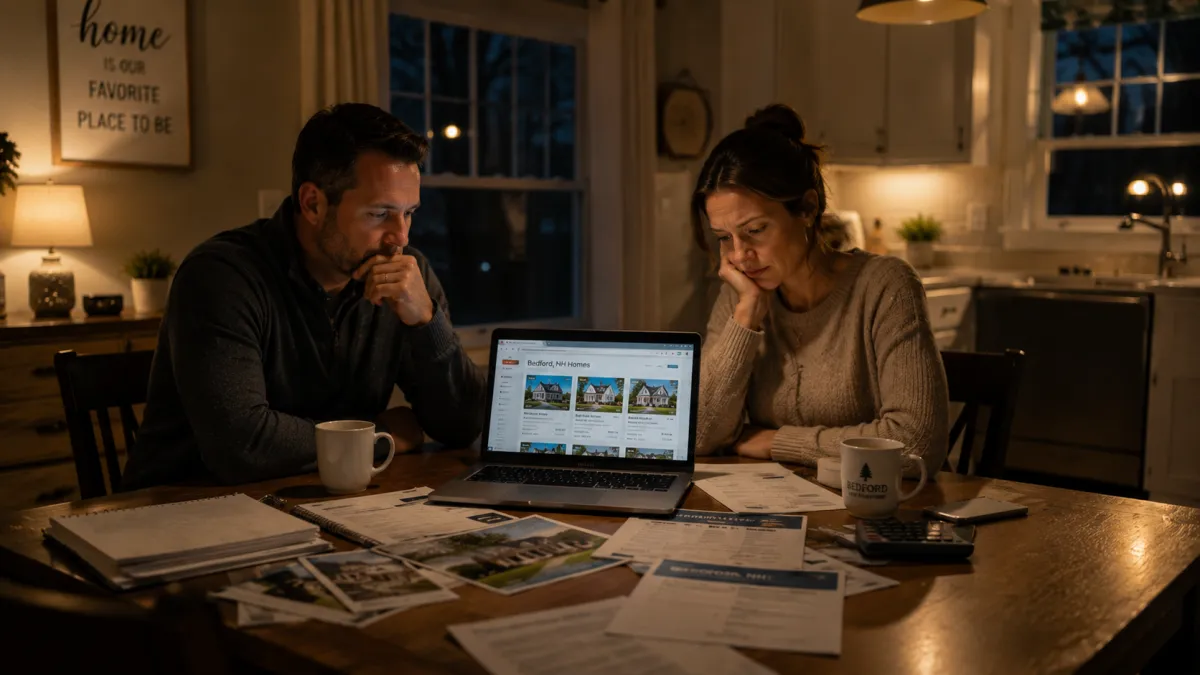
It's the quiet stress. The 10 PM what-ifs. The Sunday-afternoon spiral. The moment three days into a house hunt where you wonder if you're making the right call, the right size call, the right neighborhood call, the right life call.
I've sat with hundreds of buyers across Bedford and Southern New Hampshire over the years, and I've come to believe that the emotional landscape of buying a home is just as important as the logistical one. Maybe more important. Because the logistical part has a system. The emotional part is where people get stuck.
So today, I want to walk you through the quiet stress points I see most often — and how to move through them with less anxiety, more clarity, and the kind of calm that makes good decisions possible.
This isn't a real-estate-jargon blog. This is the conversation I have with my clients in person.
• • •
Stress Point #1: "Am I Doing This At the Right Time?"
This is the question that pops up before anyone has even toured a house.
Buyers ask it about the market. Buyers ask it about their finances. Buyers ask it about their life. Should we wait? Should we do this in spring? Should we have done this last year?
Here's the calm version of that conversation:
Timing markets is something even professionals get wrong. What works almost every time is timing your life. If your life is ready — your finances are stable, your job is steady, you know the area you want, you're staying somewhere long enough that the math works — that's the time. The market will do what the market does. Your life is the variable that matters.
When buyers move forward because their life is ready, they almost never regret the timing. When buyers move forward because they were trying to outsmart the market, they sometimes do.
If you're stuck in this loop, the question isn't "is this the right market?" The question is "is this the right chapter for me?" That's a question you can actually answer.
• • •
Stress Point #2: "Are We Looking At the Right Neighborhoods?"
This one usually shows up around tour two or three.
You start with a list. You tour. The list shifts. You feel like you don't know what you want anymore. Some homes feel right but are in the "wrong" town. Some homes are in the "right" town but feel wrong. You wonder if you've been looking at this all backward.
Here's how I help clients work through it:
We separate the house search from the life search. We make a clear list of what your weekly life looks like — where the school is, where the gym is, where the grocery store is, where the friend lives, where the work is, where the favorite walk is. We map it. Then we let that map decide which neighborhoods make the short list.
Once you can see your real life on a map, the neighborhood conversation usually clarifies fast. The list of "good" Bedford and Southern NH neighborhoods is long. The list of neighborhoods that fit your life is shorter, and once you see it, you usually know it.
• • •
Stress Point #3: "What If We Miss Something on the Inspection?"
This one is almost universal, and it's almost always about something deeper than the inspection itself.
Buyers worry about missing something on the inspection because buying a home is one of the largest financial decisions of their life and they don't want to feel like they got tricked. That's a healthy instinct.
The calming truth is this: a good inspector, with a good agent who knows what to ask, will catch what matters. No inspection catches everything. There is no version of homebuying with zero risk. But there is a version with intelligent risk — known issues, planned repairs, realistic expectations.
What I tell my clients is: don't try to make the inspection bulletproof. Make it informed. Walk through the inspection report with me. Ask what matters and what doesn't. Get pricing on the items that do. Then make a clear decision about what stays in the deal, what gets negotiated, and what you walk away from.
Inspection anxiety is usually a symptom of "I want this to be the right call." Once we turn the inspection into clear data, the anxiety usually drops.
• • •
Stress Point #4: "Did We Pay Too Much?"
This one usually hits between offer-accepted and closing.
Buyers go quiet. They scroll Zillow. They check Redfin. They look at three other listings and run the numbers in their head. They wonder.
Here's the thing about price: there is no perfect price. There is a defensible price — a price that makes sense based on comparable sales, current condition, current market dynamics, and the value the home actually creates in your life. That's the price worth paying.
A defensible price isn't always the lowest price. It isn't the most romantic price. It's the price you can stand behind in three years when someone asks you about it.
If you've been honest in negotiation, fair in evaluation, and clear on the comps, the answer to "did we pay too much?" is almost always "no — we paid what this house was worth to us, in this market, in this moment, for this life." That's the answer that holds up.
• • •

Stress Point #5: "Are We Making the Right Long-Term Decision?"
This is the deepest one. It usually shows up around the final walk-through.
It sounds like: Are we going to be happy here? Will the kids do well at this school? Will we still love this neighborhood in five years? Should we have waited? Should we have stretched? Should we have stayed where we were?
Here's the gentle reframe I offer:
You're not choosing your forever. You're choosing your next chapter. If this home, this neighborhood, this town fits your life right now and for the next several years, that's the right call. The future will reveal itself, and good decisions made today create options for tomorrow.
Most of the buyers I've worked with over the years stayed in their homes longer than they expected to. Many became part of the community in ways they didn't anticipate. The decision to buy is rarely the last decision — it's the decision that opens the door to the next chapter of your life.
That's a worthy decision. It doesn't have to be a perfect one.
• • •
What Helps Most: Slowing Down at the Right Moments
If there's one piece of advice I give every buyer, it's this: slow down at the right moments.
Speed up through the steps that should be quick — pre-approval, paperwork, follow-ups, scheduling. Slow down through the steps that deserve weight — the neighborhood walk, the inspection report review, the offer conversation, the final walk-through.
Buyers who run fast through everything tend to feel anxious throughout. Buyers who run fast through logistics and slow through decisions tend to feel calm throughout. Same total time. Different emotional experience.
I help my clients pace this on purpose. It's part of what I do. The goal isn't just to get to closing — it's to get to closing without the carryover stress of feeling like the whole process happened to you instead of with you.
• • •
The Calm Buyer's Toolkit
Here's what I'd recommend keeping close during your homebuying season:
A good lender you trust. Not just a rate — a relationship.
A clear budget that includes the real monthly cost (not just the listing estimate).
A mapped weekly life so neighborhood decisions stay grounded.
A trusted Realtor who answers your questions plainly, doesn't push, and tells you the truth even when it slows things down.
A short journal — even just a notes app — where you write down what each home felt like the day you saw it. The memories blur fast. The notes don't.
And one trusted person outside the process you can talk to when the 10 PM spiral hits. Sometimes you just need to say it out loud to someone who isn't trying to sell you anything.
• • •
My Promise as Your Realtor
If you work with me, here's what I commit to:
I'll move at your pace, not mine. I'll explain things in plain English. I'll tell you what I'd do in your shoes, even when it's not the answer that closes the deal fastest. I'll slow down when the decision deserves weight, and I'll move quickly when speed serves you.
You'll never feel pushed. You'll never be left wondering what's next. And when we close, you'll close on a home you chose with clarity — not one you ended up in because the process moved faster than your decision-making.
That's the calm buyer's experience. That's what I sell — alongside the house.
When you're ready to talk, I'm here.
