

Kimberley A. Tufts, REALTOR®
The Modern Group™ eXp Realty
Your Local Trusted Real Estate Professionals
Blog
Start searching for your new home Below ⬇️ No Login Required
Real Estate Insights
How to Price a House in Southern NH | Kimberly A. Tufts
Pricing a home is not math. Most sellers look at what they paid for the house, add the cost of renovations, compare a few nearby listings, and arrive at a number that feels reasonable. It's also one of the most expensive mistakes a seller can make.
The most effective pricing strategy uses exact comparable sales within your specific town to establish a baseline value. Setting the right number on day one attracts immediate buyer interest, prevents your listing from growing stale, and is the surest way to maximize your final return.
Difference Between Smart Pricing and Emotional Pricing
Deciding on an asking price is one of the most stressful parts of selling a home in New Hampshire. You have lived in the space, celebrated milestones there, and invested your own money into keeping it beautiful. It is completely normal to feel a strong attachment to the property.
Buyers do not have that attachment. When they view your home, they are looking at square footage, condition, location, and how the price compares to other homes they toured that weekend.
This disconnect between the seller's memories and the buyer's logic is where pricing mistakes happen. We categorize these two approaches as Emotional Pricing and Smart Pricing.
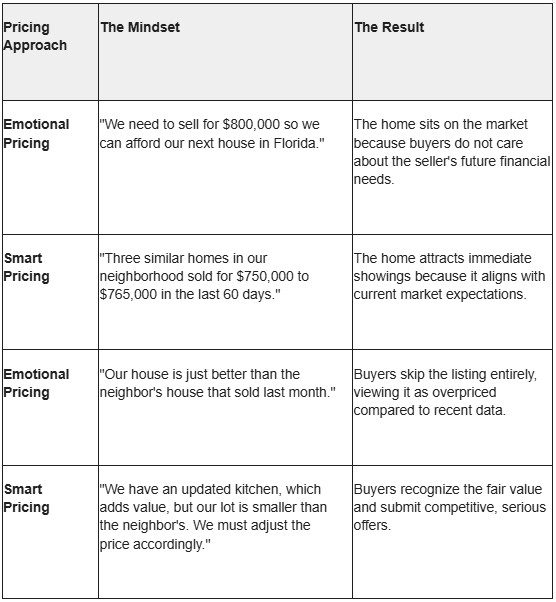
Smart pricing is a calculated business decision. It removes ego from the equation and relies entirely on measurable results.
Why Does the Dollar-for-Dollar Renovation Trap Fail?
A common misconception among homeowners is that home improvements offer a one-to-one return on investment. If you spent $60,000 on a kitchen renovation three years ago, it feels logical to simply add $60,000 to your home's base value today.
In real estate, math does not work that way. When you renovate a space, you get to enjoy the use. That enjoyment accounts for a portion of the value. By the time you sell, the renovation is no longer brand new. Buyers appreciate an updated kitchen, but they will not pay the exact retail cost of the remodel.
Here’s how buyers view renovations in Southern NH:
Personal Taste: You might have loved the dark granite countertops you installed in your Windham colonial, but the new buyer might prefer white quartz. They will not pay a premium for a design choice they plan to change.
Expected vs. Exceptional: In certain price points, buyers simply expect specific upgrades. If you are selling a higher-end property in Hollis, a finished basement or a primary suite bathroom is considered standard, not a reason to drastically inflate the price.
Invisible Upgrades: Spending $15,000 on a new HVAC system or a roof is necessary for home maintenance. While a new roof prevents buyers from asking for a discount, it does not usually add $15,000 of positive equity to your asking price.
Your pricing strategy must look at the overall condition of the home relative to the competition, rather than acting as a receipt for past contractor bills.
How Do You Find Accurate Real Estate Comps Across Different Towns?
Southern NH real estate comps (comparable sales) are notoriously tricky to calculate. If you live in a massive planned subdivision where every house has the exact same floor plan, finding a comp is easy. But most towns in our region have diverse, mixed-age housing.
You cannot use a broad brush to price a house here. Each town operates as its own distinct micro-market.
Here are some of the challenges of pricing in different communities:
Bedford: Buyers pay a premium for specific school districts and established neighborhood locations. A comp on one side of town might not apply to a similar house on the other side.
Amherst: This town is known for historic properties mixed with newer builds. You cannot compare a 200-year-old colonial village to a 10-year-old construction, even if the square footage is identical.
Londonderry & Derry: These towns attract heavy commuter traffic from Massachusetts. Proximity to Interstate 93 heavily influences the final sale price.
To find an accurate price, you must pull data from homes that share the same specific variables. We look for homes sold within the last three to six months, with similar square footage, comparable lot sizes, and equivalent private utility situations.
What Happens When You Overprice a Home in a Tight Market?
Sellers often ask, "Can we just price it high to test the market? We can always drop the price later."
This strategy is highly dangerous, even in a market with low inventory. Today's buyers are incredibly educated. They have access to the same apps and housing data that you do. When a new listing hits the market, a cross-border buyer from Massachusetts immediately compares your asking price to the rest of the neighborhood.
If your price is completely disconnected from the data, they will not even book a showing.
The Timeline of an Overpriced House:
Week 1: The house goes live. You get minimal foot traffic because agents tell their buyers the home is overpriced.
Week 3: The listing grows stale. Buyers notice the "Days on Market" ticking upward and assume something is wrong with the property (e.g., a bad roof, a failing septic system).
Week 6: You are forced to execute a price reduction. Now, you have lost your initial momentum.
Offer Time: When an offer finally comes in, the buyer bids aggressively under your new asking price, knowing you are eager to sell.
By attempting to test the market with an inflated number, you usually end up walking away with less money than if you had priced the home smartly on day one. A data-backed price creates a sense of urgency. It brings multiple buyers through the door simultaneously, which is the only reliable way to generate a strong, competitive offer.
Why Partner with Kimberley A. Tufts for Your Pricing Strategy?
I, Kimberley A. Tufts REALTOR®, help first-time sellers, move-up buyers, luxury clients, and estate-sale families across Southern NH and Massachusetts navigate one of the most important financial decisions of their lives. My mission is to simplify complex real estate decisions, so you move forward with total clarity and zero guesswork.
When you hire me to sell your home, I act as your decision filter. As a former educator, I do not believe in sugarcoating the numbers just to win your listing. I break down the exact comparable sales in your specific town, clearly explaining what the data means for you. We will have an honest conversation about smart pricing versus emotional pricing, ensuring your house is positioned correctly from the very beginning.
Backed by The Modern Group, my approach is completely grounded in measurable results. You get a calm, organized project manager who handles everything from the initial pricing strategy to the strategic marketing launch and final closing. As a mom and a Mimi who understands how disruptive a move can be, I am highly protective of my clients. I negotiate fiercely on your behalf, ensuring you receive real guidance and a smooth, structured experience.
Frequently Asked Questions About Selling in NH
How much does it cost to sell a house in New Hampshire?
Selling costs typically include real estate commissions, your portion of the New Hampshire real estate transfer tax (which is $7.50 per $1,000 of the sale price), prorated property taxes, and any necessary home repairs or staging fees.
Should I use an online estimator to price my Southern NH home?
Online automated valuation models (AVMs) are notoriously inaccurate in New Hampshire. They cannot evaluate the condition of your specific kitchen, the quality of your private well, or the specific appeal of your exact street. They only see broad public tax data.
Is it better to price slightly below market value?
In a strong seller's market, pricing slightly below the exact market value can be a smart strategy. It often triggers immediate interest from multiple buyers, which can lead to competitive bidding and a final sale price that exceeds your expectations.
Do I need to fix everything before pricing my house?
No. You do not need to execute major renovations, but you do need to price the home according to its current condition. Deep cleaning, decluttering, and fixing obvious deferred maintenance (like a leaky faucet or peeling paint) will protect your asking price without requiring a massive upfront investment.
Setting the right price for your home is the single most important step in the entire selling process. You need a strategy that relies on hard data, localized market intelligence, and a clear understanding of buyer behavior. I, Kimberley A. Tufts, can help create a data-driven valuation of your Southern NH property. Are you ready to see the real numbers for your specific neighborhood? Reach out to me for a consultation.

Power Up Your
Content Strategy
Unlock your brand's potential with our expert content marketing solutions.

Kimberley Tufts: Revolutionizing Real Estate with Integrity and Expertise
Kimberley’s commitment to her clients truly sets her apart in today’s real estate market. With more than eight years of experience, over $155M in closed volume, and 290+ homes sold, she is a top-producing 4X eXp ICON Agent and a RealTrends Verified Top 1% NH & MA REALTOR®. Her attention to detail, genuine care, and strong communication and negotiation skills have earned her a reputation for exceptional client service.
With a background in education and finance, Kimberley brings a unique ability to explain the process clearly, anticipate challenges, and guide clients through even the most complex transactions with ease. Whether you’re buying or selling, in any price point or situation, her proven track record and unwavering dedication make her a trusted partner in achieving your real estate goals.