

Kimberley A. Tufts, REALTOR®
The Modern Group™ eXp Realty
Your Local Trusted Real Estate Professionals
Blog
Start searching for your new home Below ⬇️ No Login Required
Real Estate Insights

Selling a House in Bedford, NH: What No One Tells You
Selling a home sounds straightforward in theory. List the property, accept a strong offer, and move toward closing. Most sellers spend their energy thinking about what everyone can see: the paint color, the staging, and whether to replace the kitchen countertops. However, the surprises that actually derail deals happen behind the scenes.
When you sell a property in Southern New Hampshire, you face specific financial and legal realities that national real estate advice ignores. From navigating state transfer taxes to managing the intense inspection demands of out-of-state buyers, a successful sale requires strict attention to local details.
Why Is the Highest Offer Often the Riskiest?
When you list a house in Bedford, NH, it is common to attract attention from buyers relocating from higher-priced markets like Boston. Sometimes, these buyers submit offers significantly over your asking price to beat out the local competition.
On paper, accepting the highest number seems like the obvious choice. In reality, an unusually high offer is often the most fragile.
When a buyer agrees to pay a premium, that number must be validated by the bank. If the buyer is getting a mortgage, their lender will send an appraiser to determine the fair market value of your property. If the house appraises for less than the offered price, a dangerous "appraisal gap" is created.
Here are some of the risks of accepting an over-inflated offer
Appraisal Shortfalls: If the home does not appraise for the contract price, the buyer must bring the cash difference to closing, or you must lower your price. If neither happens, the deal dies.
Out-of-State Lenders: Buyers using out-of-state banks or online lenders often face massive delays. These institutions rarely understand New Hampshire's specific closing timelines or local property nuances.
Buyer's Remorse: Buyers who bid emotionally often wake up the next day feeling panicked. They use the home inspection as an excuse to demand unreasonable repairs or back out entirely.
A slightly lower offer from a buyer using a reputable local New Hampshire lender, with a solid down payment and realistic inspection terms, is almost always a safer and more profitable choice.
How Does the New Hampshire Transfer Tax Actually Work?
One of the biggest financial surprises for sellers in Southern NH is the state transfer tax. Because New Hampshire does not collect a general state income tax or sales tax, the state relies on other methods to generate revenue, including taxes on real estate transactions.
The New Hampshire Real Estate Transfer Tax is currently set at $15 for every $1,000 of the property's sale price.
By standard practice, this tax is divided equally between the buyer and the seller. This means you, as the seller, are responsible for paying $7.50 per $1,000 of the final sale price right at the closing table. This fee is deducted directly from your proceeds.
Many sellers fail to factor this into their net sheet when deciding on a list price. To understand exactly how this impacts your bottom line, look at the math for typical Bedford home values:
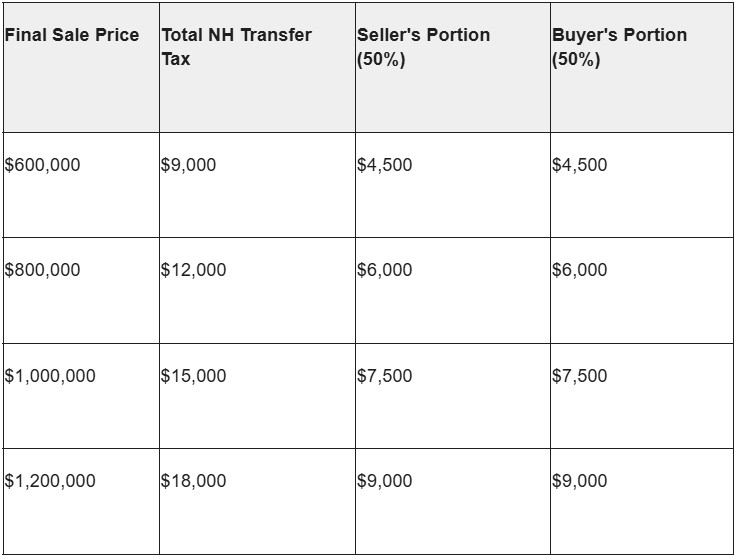
Knowing this number upfront prevents stressful surprises on closing day and helps you calculate exactly how much equity you will walk away with.
What Do Massachusetts Buyers Expect During Inspections?
Bedford attracts a high volume of buyers moving north from Massachusetts. These buyers are used to living in towns with municipal water lines and public sewer systems. When they cross the border and realize your Bedford home relies on a private well and a septic system, they frequently become nervous.
Because these systems are foreign to them, cross-border buyers demand rigorous and exhaustive inspections.
The Septic System Hurdle
The Town of Bedford has strict regulations regarding septic systems. Local health ordinances dictate that all systems must be properly maintained to prevent groundwater contamination. If a buyer's inspector finds that your septic tank is failing or that the leach field is saturated, the repair costs can quickly escalate into the tens of thousands of dollars.
To prevent a buyer from walking away, you must pump your septic tank and have it evaluated by a local professional before you list the home. Having a clean bill of health ready to show prospective buyers completely removes their anxiety and protects your asking price.
The Private Well Reality
Similarly, Bedford requires specific water quality testing for new or replacement wells, checking for naturally occurring elements like arsenic, iron, manganese, and radon. Buyers will test your well water for all of these parameters, plus bacteria.
If your water test comes back with high levels of radon or arsenic—both very common in New Hampshire bedrock—the buyer will ask you to install a mitigation system. By testing your own water early, you can install necessary filtration systems on your own terms, rather than rushing to hire an expensive contractor days before closing just to appease a panicked buyer.

The Hidden Realities of Preparing a Bedford Home
Selling a house in NH requires strategic preparation. You cannot simply clean the counters and expect top dollar. Today's buyers, particularly those looking in Bedford's price points, have high expectations. They want a home that feels entirely turnkey.
This requires brutal objectivity about your own living space. When you live in a house for years, you stop noticing the scuffed baseboards, the crowded closets, and the overgrown landscaping. Buyers notice immediately.
Before any photographs are taken, you have to execute a deep level of organization. This means packing away personal photographs, clearing out basements, and removing excess furniture to make the rooms feel larger. Sometimes, it involves bringing in professional stagers to ensure the home's layout makes sense on camera. A home that looks pristine online will drive significantly more foot traffic, resulting in better, more secure offers.
How Do You Protect the Deal From Contract to Closing?
Getting a buyer to sign the purchase agreement is only half the battle. The period between the accepted offer and closing day is where most deals face the threat of falling apart.
During this phase, there are dozens of moving parts. The buyer's lender must order the appraisal. The title company must search for liens or encumbrances on your deed. The home inspectors must coordinate access to the property.
If any of these parties miss a deadline, your closing date gets pushed back. If you are simultaneously trying to buy a new home while selling your current one, a delayed closing can cause a disastrous domino effect, potentially leaving you without a place to live.
To survive this phase, you need a single point of contact who acts as a strict project manager. This manager tracks every deadline, follows up with uncommunicative lenders, and negotiates fairly but firmly when the buyer attempts to ask for last-minute concessions based on a minor inspection finding.
Why Partner With Kimberley A. Tufts to Sell Your Home?
I, Kimberley A. Tufts REALTOR®, help move-up buyers, luxury clients, and estate-sale families across Southern New Hampshire navigate one of the most important financial decisions of their lives. My mission is to simplify complex real estate decisions, so you move forward with total clarity and zero guesswork.
When you hire me as your Bedford, NH, real estate agent, you are not getting a salesperson. You are getting an educator and a fierce advocate. I rely on market data, not opinions, to price your home correctly from day one. I use a structured 8-Phase Seller Roadmap that breaks down the entire process—from deep cleaning and staging to professional media and the final strategic marketing launch.
Selling a house is naturally stressful, but the execution should be calm. Backed by the strong team at The Modern Group, I manage the timeline, coordinate with all parties, and protect your equity during negotiations. You receive clear strategy, calm guidance, and measurable results.
Frequently Asked Questions About Selling in NH
Do I have to pay capital gains tax when selling a house in NH?
New Hampshire does not have a state-level capital gains tax. You will still be subject to federal capital gains tax rules, which generally allow individuals to exclude up to $250,000 of profit (or $500,000 for married couples) if the home was your primary residence.
Who pays the real estate transfer tax in New Hampshire?
By state law and customary practice, the New Hampshire Real Estate Transfer Tax is split equally between the buyer and the seller. Each party pays $7.50 per $1,000 of the final sale price.
Can I sell my Bedford home without fixing the septic system?
If your septic system is in acute failure, Bedford local ordinances and NH state laws heavily restrict the transfer of the property. In most cases, you must repair or replace a failing system, or escrow funds at closing, to successfully sell the home to a buyer using traditional bank financing.
How long does it take to close on a house in NH?
Once an offer is accepted, the typical timeline to close on a house in New Hampshire is 30 to 45 days. This window allows enough time for the buyer to complete their home inspections, secure their mortgage approval, and for the title company to prepare the final legal documents.
Selling a house in Bedford, NH, does not have to be an unpredictable or stressful event. By understanding the local tax structures and preparing well, you retain complete control over your sale. If you are ready to position your home correctly and want a data-driven expert on your side, reach out to me today to begin your personalized selling strategy.

Power Up Your
Content Strategy
Unlock your brand's potential with our expert content marketing solutions.

Kimberley Tufts: Revolutionizing Real Estate with Integrity and Expertise
Kimberley’s commitment to her clients truly sets her apart in today’s real estate market. With more than eight years of experience, over $155M in closed volume, and 290+ homes sold, she is a top-producing 4X eXp ICON Agent and a RealTrends Verified Top 1% NH & MA REALTOR®. Her attention to detail, genuine care, and strong communication and negotiation skills have earned her a reputation for exceptional client service.
With a background in education and finance, Kimberley brings a unique ability to explain the process clearly, anticipate challenges, and guide clients through even the most complex transactions with ease. Whether you’re buying or selling, in any price point or situation, her proven track record and unwavering dedication make her a trusted partner in achieving your real estate goals.